


Additional tax on fossil-fuel company cars from 2027
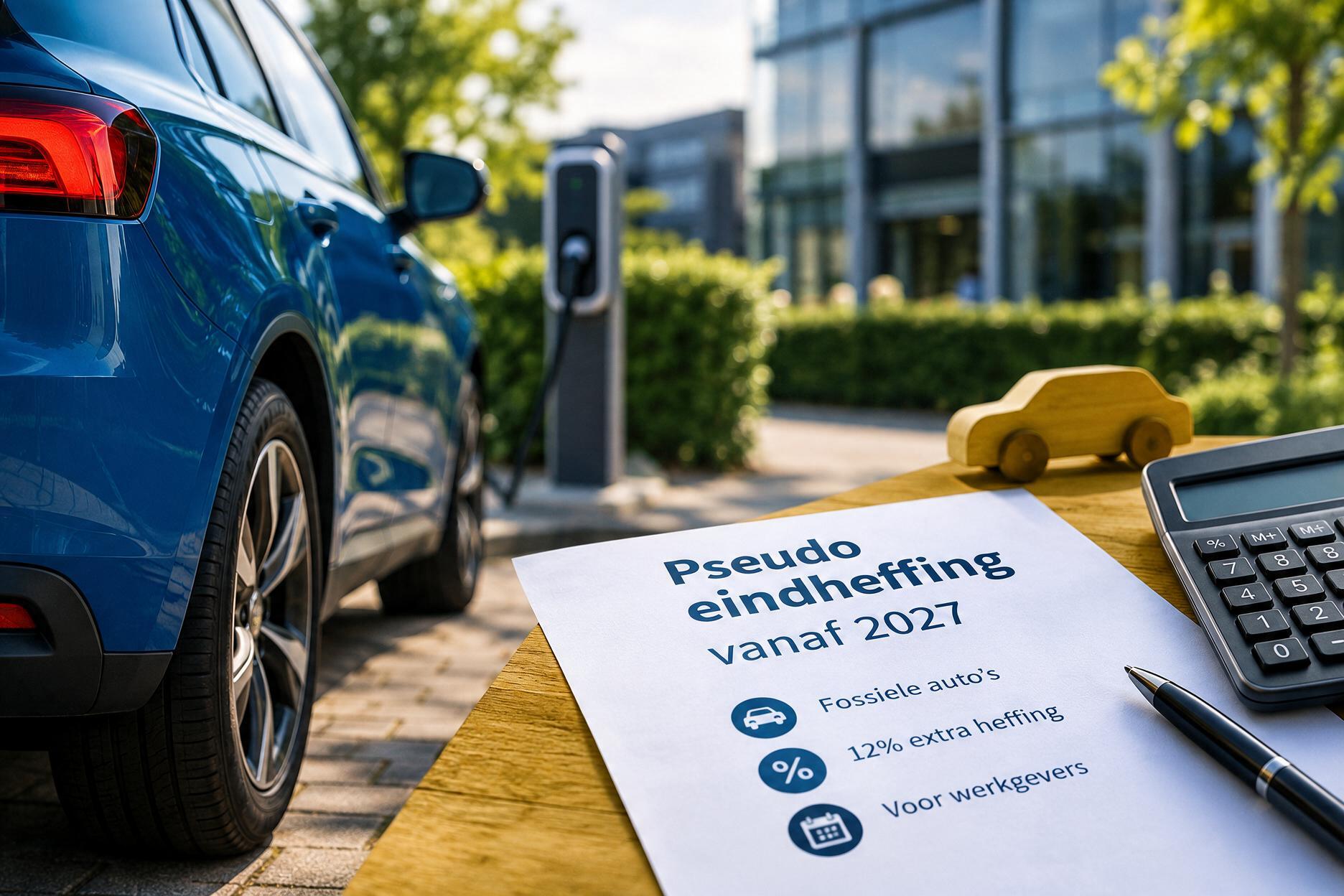
Employers with a vehicle fleet will face a new tax measure starting in 2027. For fossil-fuel passenger cars made available to an employee for the first time as of January 1, 2027, which may also be used privately, an additional employer’s levy of 12% applies. This therefore also applies to the director and major shareholder (DGA) who receives a salary from their holding BV. This so-called pseudo-final levy (pseudo-eindheffing) comes in addition to the existing taxable benefit (bijtelling) for the employee.
For entrepreneurs with employees and a company car, it is therefore wise to assess now what consequences this measure will have for the fleet and mobility schemes (mobiliteitsregelingen).
Topics
- What will change starting in 2027?
- What are the costs?
- When will an employer be subject to the levy?
- No addition to income (bijtelling), but potentially a pseudo-final levy (pseudo-eindheffing).
- How can an employer avoid the levy?
- Existing fossil-fuel cars: transitional arrangement.
- New exception for replacement transport
- Temporary rental cars may also be exempted.
- Exemption for driving school cars.
- What does this mean for your business?
- Do not wait until 2027.
What will change starting in 2027?
From January 1, 2027, the employer will pay a pseudo-final levy (pseudo-eindheffing) of 12% per year on the value of a fossil-fuel passenger car made available to an employee for private use. For the purposes of this scheme, private use also includes commuting.
The levy applies to passenger cars running on fossil fuels, which also includes hybrid and plug-in hybrid cars. Fully emission-free cars, such as electric and hydrogen cars, fall outside this levy. Delivery vans (bestelauto’s) are also not covered by this specific scheme.
The pseudo-final levy is an employer cost. The employer is not permitted to recover this tax from the employee. Furthermore, the employee will continue to deal with the normal addition to income (bijtelling) when the car is also used privately.
What are the costs?
For a car with a list price (cataloguswaarde) of €50,000, the pseudo-final levy amounts to:
12% × €50,000 = €6,000 per year
That is €500 per month.
With ten cars of the same value, the annual levy already rises to €60,000. For larger fleets, the financial impact can therefore be significant.
For cars up to 25 years old, the list price including VAT and BPM (private motor vehicle and motorcycle tax) is used. For cars older than 25 years, the fair market value (waarde in het economische verkeer) applies.
When will an employer be subject to the levy?
The most important condition is that it concerns a fossil-fuel passenger car that is made available for private purposes for the first time starting from January 1, 2027.
In this regard, it is important not only to look at the purchase date of the car. An existing car that is only made available to an employee for private use for the first time from 2027 onwards can also fall under the levy.
Furthermore, an employee does not actually have to drive many private kilometers. For this scheme, making the car available for private purposes is decisive. Commuting is also classified as private use in this context.
No addition to income (bijtelling), but potentially a pseudo-final levy (pseudo-eindheffing)
An important point of attention is the situation in which an employee uses a fossil-fuel company car exclusively for business purposes. In that case, no addition to income is due under the normal rules (bijtelling). However, this does not automatically mean that the pseudo-final levy is also waived.
The reason for this is that the rules for private use are not the same for the normal addition to income and for the pseudo-final levy. For the normal addition to income (bijtelling), commuting is classified as business use. For the pseudo-final levy, commuting is specifically classified as private use.
This can therefore mean that a car for which no addition to income is due still falls under the pseudo-final levy. It is therefore important, in the case of a so-called ‘fully business’ used car, to look closely at the actual trips and the location where the employee performs their work.
A special situation can arise when the business address of the BV is established at the entrepreneur’s private address. A trip from that address to the business address is then not a commute. A trip from the business address to a client is also business-related. This could lead to the car not being made available for private purposes for the pseudo-final levy.
However, there is currently no definitive clarity regarding this specific situation. For the final application, it will therefore be necessary to wait and see how this is interpreted in legislation, regulations, and implementation practice.
How can an employer avoid the levy?
There are several possibilities to avoid the pseudo-final levy (pseudo-eindheffing).
- Choose an emission-free passenger car
The most obvious solution is a fully emission-free passenger car. An electric or hydrogen car does not fall under the pseudo-final levy. Note that a hybrid or plug-in hybrid car is not classified as emission-free for this scheme. - Do not make a passenger car available
An employer can also choose not to make a corporate passenger car available and instead work with, for example:
• a mobility budget;
• a travel allowance;
• public transport;
• a bicycle or scooter;
• a corporate delivery van, if appropriate for the work activities.The chosen solution must, of course, actually fit the employee’s mobility needs.
- No private use
When a fossil-fuel passenger car is used exclusively for business and is not available for private purposes, the pseudo-final levy does not apply.A key difference here from the normal addition to income (bijtelling) rules is that a limit of 500 private kilometers does not serve as a safe lower limit. For the pseudo-final levy, it is essential that the car is not made available for private purposes at all.
An employer is therefore well-advised to clearly record the agreements regarding the use of the car and to ensure the administration aligns with this.
Existing fossil-fuel cars: transitional arrangement
A transitional arrangement applies to fossil-fuel passenger cars that were made available to an employee for private use for the first time before January 1, 2027.
According to the current legal regulations, this transitional right runs until September 17, 2030. The cabinet has since announced its intention to extend this period until January 1, 2031.
In practical terms, this means that employers who already have fossil-fuel cars in their fleet do not have to replace all these cars by January 1, 2027.
Please note: the extension to January 1, 2031, has been announced but still needs to be legally finalized. For final newsletters or advice, it must therefore be verified whether the announced change has actually been established in legislation.
Furthermore, an important point of attention is that the transitional right is linked to the employer. If the same car is made available to another employee of the same employer during the transitional period, the transitional right can be maintained. In the event of a move to a different employer, the transitional right generally does not transfer.
New exception for replacement transport
A major bottleneck in the original scheme was the use of a fossil-fuel replacement car.
Consider, for example, an employee who normally drives an electric company car but must temporarily do without it due to:
• damage;
• repair;
• maintenance;
• a tire change.
The cabinet has announced the introduction of an exception for this. A fossil-fuel replacement passenger car should remain outside the pseudo-final levy for a maximum of 14 consecutive calendar days.
This is particularly relevant for employers who normally have their employees drive fully electric. An incidental loaner car then does not have to lead directly to an additional tax levy. This is also an important relaxation for garages and body shops.
This exception has been announced but still needs to be legally finalized.
Temporary rental cars may also be exempted
Additionally, the cabinet has announced a second relaxation. Until January 1, 2031, it would become possible to make a fossil-fuel passenger car available for one period of a maximum of seven consecutive calendar days per calendar year without the pseudo-final levy being due. This can be relevant, for example, for temporary rentals or other short-term use.
For employers who only incidentally need an extra car, this can be an important practical solution.
The same applies here: the exception has been announced and is not yet definitively included in the law.
Exemption for driving school cars
The cabinet has also announced a specific solution for driving schools. Driving school cars would be exempted from the pseudo-final levy.
This is especially important for driving schools that still use fossil-fuel vehicles for their business operations. The precise conditions of this exemption must still emerge from the final legislation and regulations.
What does this mean for your business?
For many employers, this is not a matter that should only be considered in 2027. Decisions made in 2026 regarding the purchase, lease, and replacement of cars can have financial consequences for years.
We therefore advise reviewing at least the following points before the end of 2026:
- Map out the fleet
Which passenger cars are fossil-fuel, hybrid, or fully emission-free? - Check the date on which cars were made available
This can be decisive for the transitional right. - Calculate the potential annual levy
For every new fossil-fuel passenger car, 12% of the relevant value can represent a significant annual cost item. - Review lease contracts
A contract that continues after 2026 can have consequences for the tax position of the car. - Look at employees who change cars or employers
The transitional right may be lost in these cases. - Make arrangements for replacement transport
Particularly with electric cars, it is wise to determine in advance how damage, maintenance, and repairs will be handled. - Assess alternatives
Consider electric cars, mobility budgets, mileage allowances, or other forms of transport.
Do not wait until 2027
The pseudo-final levy (pseudo-eindheffing) can become a significant structural cost for employers. At the same time, the announced relaxations offer room for practical solutions.
Because some of these changes currently still need to be converted into definitive legislation and regulations, it is wise to distinguish between the rules that are already fixed and the announced changes when making decisions about the fleet.
Do you have employees with a corporate car? Then it is advisable to have the implications of the new rules for your business assessed now and to determine which choices are prudent before 2027.

Wubbo Staal
Partner/owner and Registered Tax Advisor
Although the utmost care has been taken in the compilation of this blog, no liability is accepted for omissions or inaccuracies. This blog is for informational purposes only and no rights can be derived from its content. For application in individual cases, we recommend that you contact us.